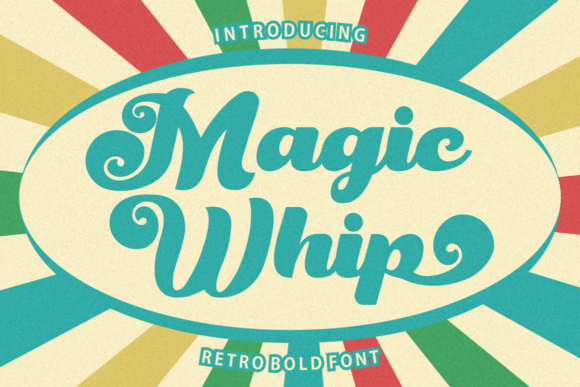
Bringing Back the Groove: A Deep Dive into Magic Whip
In the vast sea of modern typography, finding a typeface that genuinely captures a specific era without feeling like a cheap imitation is rare. We often see fonts that claim to be "retro" but end up looking cartoonish or dated in a bad way. However, Magic Whip—specifically The Magic Whip - Retro Script Bold Font—breaks that mold. It is a thick, groovy script font that doesn't just nod to the past; it pulls the best elements of 1970s and 80s design into the present day. For designers, entrepreneurs, and content creators looking to inject personality and nostalgia into their work, this font offers a distinct voice that is hard to ignore.
The Visual Personality: More Than Just a Script
When you first look at Magic Whip, the immediate impression is one of weight and fluidity. It is categorized as a bold script, meaning the strokes are substantial and fill their space with confidence. This isn't a delicate, whispering calligraphy font; it’s a loud, vibrant declaration. The visual characteristics are rooted in the "fat" lettering styles popularized in the mid-20th century, where strokes expanded to create a sense of fun and availability.
The appeal lies in its versatility within the retro niche. It balances on the fine line between a handwritten font and a structured script font. While it mimics the natural flow of a pen or brush, the baseline and x-height are consistent enough to ensure legibility. This makes it an excellent choice for logo design where brand recognition is paramount. The font exudes a personality that is friendly, approachable, and undeniably cool—qualities that resonate with audiences ranging from Gen Z discovering vintage aesthetics to Gen X appreciating a callback to their youth.
Unlocking Creative Potential with Alternates
One of the most practical features of this premium font is the inclusion of a wide range of alternative characters. In professional design work, repetition is the enemy. If you are creating a headline for a poster or a brand name for a new coffee shop, seeing the exact same letterform twice in a word can look amateurish. Magic Whip solves this by offering stylistic alternates and ligatures.
Because the font is PUA encoded (Private Use Areas), accessing these glyphs is seamless. You don’t need to be a typography expert with advanced software knowledge to use them. Whether you are working in Adobe Illustrator, Photoshop, or even Canva, you can easily swap out letters to create a custom, hand-lettered look. This feature is invaluable for packaging design, where the product name needs to look unique and crafted specifically for that box or bottle.
Practical Applications: Where Magic Whip Shines
Understanding where to deploy a specific typeface is just as important as the font itself. Magic Whip is a display font, meaning it is designed for large sizes and short bursts of text. It excels in environments where impact is required immediately.
Branding and Identity
For entrepreneurs building a brand identity, consistency is key, but personality is the differentiator. If your brand voice is casual, energetic, or nostalgic, Magic Whip can serve as the anchor for your visual language. It works exceptionally well for businesses in the food and beverage industry, lifestyle blogging, streetwear, or music. Imagine this font on a bakery logo or a brewery label; the thick strokes convey substance and quality, while the script style suggests craftsmanship.
Digital and Print Marketing
In the realm of digital marketing and social media graphics, attention spans are short. You have milliseconds to stop a user from scrolling. A bold, retro headline set in Magic Whip can act as a visual anchor on an Instagram post or a YouTube thumbnail. Similarly, in editorial design, such as magazine covers or feature headlines, it provides a break from the standard corporate sans-serifs, inviting the reader into a more relaxed or creative story.
Event and Merchandise
Think about wedding invitations for a vintage-themed event, concert posters for a funk band, or merchandise like t-shirts and tote bags. The thick construction of the letters ensures that the design holds up when printed on fabric or textured paper. Unlike thinner serif fonts or sans serif fonts that might disappear into the background, Magic Whip demands attention.
Typography Strategy: Pairing and Readability
No font exists in a vacuum. A common mistake in modern typography is using a decorative script for everything. If you set an entire paragraph in Magic Whip, you will likely create a readability nightmare. The strength of this font is in the hierarchy.
Creating Visual Hierarchy
To use Magic Whip effectively, pair it with something neutral. A clean sans-serif font (like Helvetica, Montserrat, or a geometric sans) creates a beautiful contrast. The sans-serif handles the body copy—providing clarity and ease of reading—while Magic Whip handles the headlines, pulling the eye in and setting the mood. This contrast is a fundamental principle of design assets management; you balance the "loud" with the "quiet."
Evaluating Project Fit
Before committing to Magic Whip for a project, ask yourself about the audience. If you are designing a legal brief or a medical report, this font is obviously the wrong fit. However, if you are creating a menu for a retro diner, a flyer for a garage sale, or branding for a creative agency, it is an ideal candidate. It speaks to an audience that values style, creativity, and a bit of rebellion against the sterile, corporate look.
Technical Considerations and Commercial Use
For the hobbyist or crafter, the ease of use is a major selling point. Because it is a commercial font designed with user experience in mind, you don't need to struggle with complex kerning tables to make it look good. The spacing is generally well-balanced out of the box.
However, professionals should always review the licensing. If you are using Magic Whip for a client's logo or a product that will be sold commercially (like t-shirts or mugs), ensure you have the appropriate commercial license. This protects you and your client legally and supports the type designers who created the asset.
Final Thoughts on the Retro Revival
Trends in design are cyclical, but the fascination with the 70s and 80s seems to have staying power because it represents a time of bold expression. Magic Whip captures that spirit perfectly. It is not just a font; it is a mood setter. By incorporating this typeface into your toolkit, you gain the ability to instantly transport your audience to a different time, creating designs that feel nostalgic yet fresh. Whether you are crafting a brand identity, designing a poster, or creating social media content, this font provides the bold, groovy foundation needed to make your work stand out.